Category Archives: tutorials

The Cast Iron Chronicles: Part 2

Okay, we’re back with part two of The Cast Iron Chronicles!  This weekend I took a good long crack at the pan, in total spanning approximately 3 episodes of Criminal Minds. My first step was to knock the gunk and as much rust as possible off with steel wool.  Now, I know what you’re thinking.  1) Why didn’t I just use an electric dohickey with a sanding attachment (I know for a fact that the Capt’n is thinking that as he send me an email suggesting that I attack it that way) or 2) Why don’t I just cover it in oven cleaner and let it soak overnight?

So for one- we don’t have any electric dohickeys, and I figured that’s why I have hands. And arms.  I know it would be faster to use power tools, but I’ve got plenty of Criminal Minds in my Netflix queue and all winter to work on this pan.  I’m in no rush.  As for the oven cleaner- because cast iron is such a porous  material I don’t want to use anything on this pan that I wouldn’t squirt on top of my eggs.  Cast iron has a tendency to retain the flavor of things and I don’t care to take the risk with oven cleaner, even if it would probably burn off later in the seasoning process.  I’m very careful with all my cast iron, I never use soap to clean them, only ever hot water. According to my Uncle Everett, Sybil only ever used salt to clean her cast iron, no water at all. So, no harsh chemicals during this process.  Just good old fashioned scrubbing.

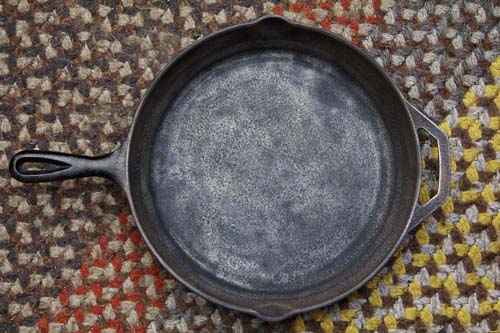
I worked on the pan for about 2 1/2 hours. I removed all the pieces of debris and a large amount of the rust.  My plan is to continue with the steel wool and then transition to the coarse sand paper as needed.  I’m already beginning to see through the rust, there’s a light at the end of the tunnel!  I’m so glad to hear that y’all are interested in this process, I am personally loving it.  There’s nothing like sanding the hell out of a piece of metal to take your mind off of the stresses of daily life.

Part 1

My posting schedule for this series will be a little behind the actual work I’m doing, so if you’d like to stay up to date check twitter and instagram (user: biscuitsandsuch). Not an iPhone user? Webstagram or Flickr will have the photos!

The Cast Iron Chronicles: Part 1

As you can guess from pretty much every post on this blog, I am deeply devoted to cast iron.  In fact, in the hierarchy of food related things that I love I’m pretty sure it goes 1. Pie 2. Bagel Sandwiches 3. Cast Iron.  And often, #3 is an important factor in achieving #1 and #2.  There’s something magical about cast iron- it’s durable, non-stick, beautiful, reliable.  Consistent.  It’s everything that my very expensive stainless steel pans are not.  In fact, in the years that we’ve had both cast iron and stainless steel our cast iron has never left our stove top.  It moves seamlessly from fried pickles to caramel to sopapillas.  Can you tell I love it?

Today I’d like to introduce a new series on Biscuits and Such, The Cast Iron Chronicles.  Creating series, sharing behind-the-scenes peeks, tutorial posts, and overusing the ever controversial serial comma are all part of the big-picture goals for 2012.  As long as that sounds good to you, of course.

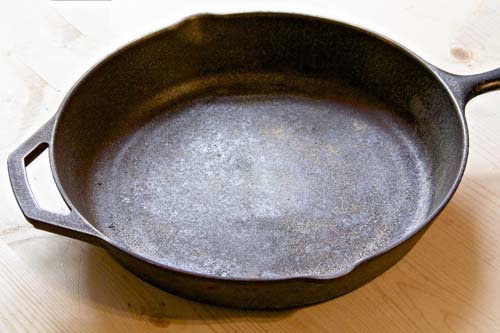
Anyway, back to The Cast Iron Chronicles.  My friends Brit & Aaron (coconspirators in the Dan-turns-27-party plan) recently moved from LA to Alexandria.  When they moved into their new house they found (among other things) this cast iron pan in their back yard.  As you can see, it’s in bad shape.  Covered in rust, battered and weather-worn.  I immediately claimed it.  They brought it up when they came for the party and today I finally took a crack at it.

This series, probably four or five installments, will follow the pan as I remove the rust, dirt, and grime and bring this beauty back to her former glory. My plan is to use a combination of steel wool, sand paper, and vegetable fats to remove the rust and season it again. The Capt’n gave me a few tips, as he has restored many a cast iron cookware item in his day, including Sybil’s cauldron. Even so, I’d love to hear any tips you have for conditioning cast iron, or anystories from your own projects. This should be a fun ride!

Picking Crabs, Maryland Style

Since I moved to Maryland in 2004 I have not eaten a whole crab. I’ve eaten plenty of crab cakes, more crab dip than I’d like to admit, a few crab pretzels, and a fair amount of crab laden sushi. But no whole crabs. In fact, the only time I’ve ever had a whole crab was at my stepgrandfather’s house in high school. We were there for Pop-Pop’s birthday, and in tribute to his Baltimore roots we ate crabs. Or, rather, my family ate crabs. I got as far as a lung (nobody told it was the lung!) and decided I preferred hot dogs.

Enter my friend Jamie. Jamie comes from a long line of proud Marylanders, people who spend as much time picking apart crabs as us Carolinians do picking apart pigs. They’ve refined the process to a science, an art, and Jamie was willing to teach it to us. I had this post scheduled for later this month, but last night Pop Pop passed away. Pop Pop, or Al Hlavin, Sr, was my stepmom Maddie’s father. He was a smart, kind, and much loved man. So, in honor of Pop-Pop and thanks to Jamie, I would like to present a step-by-step guide to picking crabs, the Maryland way.

Step 1: Start with a whole, steamed crab. Preferably one that has been steamed in copious amounts of Old Bay.

Step 2: Rip the claws off. Eat any meat that comes off with them.

Step 3: Use a knife, mallet, or your fingers to crack open the claws. Eat the meat inside.

Step 4: Locate the apron. This is the monument-shaped area on the underside of the crab.

Step 5: Pull the apron off by the tip. Discard.

Step 6: Pull the top of the shell off, from the top.

Step 7: Remove the organs. This is everything offcolored, squishy, etc in the middle of the crab. Next, remove the lungs (see where Jamie is pointing). Growing up, Jamie was told the lungs were called the devil. Number 1 rule of crab picking? DON’T EAT THE DEVIL.

Step 8: Break the crab in half.

Step 9: Use a knife to cut the half again.

Step 10: Enjoy! Eat the white meat, drink lots of beer!

Biscuits 101

This week I was featured on a joint collaboration between Paula Deen and Kraft- an online publication called Live Richly.  A new venture, part of their Real Women of Philadelphia efforts, they’ll be promoting a blogger every other Thursday in a feature called “Build a Better Blog.”  I was honored to be the first blogger they spoke with and love the finished product.  I was also really touched by the kind words that were left on the Q&A and would like to welcome new readers!  We’re happy to have you joining us!

In the interview, they marked my answers with the name biscuits.  Since it went live yesterday half the Museum staff and a few family members have decided this is the perfect nickname for me.  With the exception of my life-long nickname, Enie (given to me by my cousin Taylor, five days my junior, who couldn’t pronounce Elena), I’ve never had nicknames.  So I’m a little excited about this development.

At the beginning of last month a reader asked if, after we were done with the pie craze, I could do a 101 on biscuits.  In the past with things like burgers and steak we’ve done tutorials at the request of readers and so I was glad to get this one, particularly as biscuits are kind of our thing. Okay, pie is kind of our thing but “biscuits and such” had a better ring to it, way back when.

The key to biscuits, as with any dough, is getting the fat to flour ratio right.  All of the ingredients are important, but you won’t get the flaky, delicious layers unless you treat the butter just right.  Which brings me to my next point, which is that while I have used vegetable shortening and lard in biscuits before, I prefer a combination of butter and heavy cream.  I also use a combination of pastry flour and self rising flour, and both baking soda and baking powder.

To start with biscuits, you combine your dry ingredients.  Whisk (which will lighten the flours) together 1 1/4 cup self rising flour,  3/4 cup pastry flour (or cake flour), 3/4 tsp baking powder, 1/8 tsp baking soda, 1/2 tsp salt, 1 tbsp sugar, and any herbs/spices (like rosemary or green onions) that you’re interested in adding.  Whisk all the ingredients so that they are light and fluffy.  Now it’s time to add your butter, which should be COLD.  Cube four tablespoons of butter and, using, your fingers, work it into the flour.  I like to smooth the butter out into long, thin pieces.  This way, when you press the dough out later, it forms layers of butter between the flour, which is what makes the flakes.  Work the butter quickly so that your hands don’t warm it too much.

Next, it’s time to stir in 1 1/4 cups heavy cream.  Stir it in with a wooden spoon, bringing together all the ingredients until they form a rough ball.  It should be on the sticky side as it is always easier to work more flour in than it is to fix a dry dough.  Sprinkle a little all purpose flour on the countertop and dump your dough out.  Using floured hands gently press the dough out flat.  I like to work it a little at a time, working it out and then flipping it so that no one area or side gets too worked.  Continue to press it out until it is 1/2″ thick.  If at any time it starts getting sticky, pop it into the fridge for 20 minutes.

Now it’s time to cut the biscuits.  You’re welcome to cut them free-form, with cookie cutters, a glass jar, or a proper biscuit cutter.  As long as they end up portioned, it doesn’t matter.  Heat your oven to 475, cut them into shapes, and place them on an ungreased pan.  The last thing you want to do before baking is give them a glaze.  I like to take the measuring cup that I used to measure out my cream, stick 2 tbsp of butter in there, and melt the butter in the microwave.  Then I brush the butter/cream on my biscuits.  Bake for 10-12 minutes.

As they bake your biscuits will rise into delicious, flaky treats.  Control yourself and let them rest for 10 minutes before you cut them (any sooner and they’ll crumble). After that they are the perfect vessel for jam, butter, a spicy chicken filet, or bacon egg and cheese.  Or you may simply indulge yourself with a perfectly wonderful biscuit.  Enjoy!

Fried Turkey

I know I’ve said this before, and I know I’ll say it again, but Thanksgiving is my favorite holiday.  And I am not happy, friends, that my favorite holiday gets the short end of the stick every year.  On Saturday we went out to procure a turkey fryer so that we could have ourselves a fake Thanksgiving on Halloween.  As in, almost a month before Thanksgiving and not only did they have the dinkiest display of turkey fryers on the planet,  they had a GIANT Christmas display.  A MONTH BEFORE THANKSGIVING! When did we stop acknowledging this most delicious of holidays?!?

One of my favorite things about writing a food blog is fake Thanksgiving.  Because while I live for real Thanksgiving, it’s still a holiday.  Which means that it’s an event.  An event with amazing food, but an event nonetheless.  Fake Thanksgiving has all of the food but none of the kicking your sister out of your favorite chair so you can eat your 12th twice baked potato in peace-ness.  Or whatever.  My point is- all the glory, none of the tears.

This year we decided we would fry a turkey for fake Thanksgiving.  It was both absurdly easy and completely terrifying.  I don’t remember when it was that my father started frying turkeys, but it’s been a family tradition for quite some time now.  And the end result is something almost too delicious to describe.  It’s my ideally cooked turkey, and after last year’s absurdly defective situation I wanted this year to be perfect.  And it was.  The turkey, which had, upon entering the fryer, been brining for two days, was moist and juicy with the crispiest of skin.  It’s perfection.  Total and complete perfection.

The purpose of a brine is to make the turkey moister, but is something you should only do on fresh turkeys.  Inspired by the holiday favorite decoration of oranges studded with cloves, I brined the turkey with orange peels, whole cloves, bay leaves, orange juice, garlic, and brown sugar.  I was skeptical of whether the fried turkey would still taste like the brine but, amazingly, it did!  Worlds better than a marinade, I’ll never not brine a turkey again.

After two days in the brine, it was time to fry that baby (all 12 hunking pounds of it).  We heated the oil to 375, put the turkey on the hanger, and (very cautiously) dunked that bad boy.  And then it bubbled like crazy and I was getting concerned we’d become some All State commercial when it calmed down and simmered nicely for 40 minutes.  When it came out, perfectly cooked and smelling like heaven, I’ve never felt more gloriously triumphant.  And then we fried some oreos.

Fried Turkey from elena rosemond-hoerr on Vimeo.

Fried Turkey

Brine:

2 oranges

2 cups orange juice

2 gallons water

3/4 cup kosher salt

1/4 cup whole cloves

3 bay leaves

1 tbsp allspice berries

5 cloves garlic, chopped

1 cup brown sugar

Turkey:

1 12-15lb turkey

Oil to fill your fryer (peanut or canola)

A turkey frying kit, preferably.  A safe one.

Two days before you’d like to cook your turkey, combine the peel of two oranges, orange juice, water, salt, cloves, bay leaves, brown sugar, garlic, and allspice berries in a large pot.  Stir until salt and sugar have dissolved.  Bring to a boil and then let cool completely.  Submerge your turkey in the brine, cover, and let sit for two days.

When you’re ready to fry, heat your oil to 375.  Follow the instructions on your fryer.  Cook for 3 minutes per pound of turkey.  Remove from oil and allow to cool for 1 hour.